

From Outreach to Evidence: The Data Gap in Community Health
Share on social media


Dr. Noel Kivuyo is from Tanzania and works as an Emergency Medicine and Intensive Care registrar. He is also the co-founder and CEO of Health Community Outreach Program (HCOP) Tanzania and Medical Connect Africa. He works on community health outreach and capacity-building projects that focus on making it easier for people in underserved areas to get medical care through health education, medical camps, and preventive ser-vices. His work connects clinical care with community-based interventions. He is very interested in making health systems stronger through volunteering, early intervention, and getting people involved in their communities.
In the intensive care unit, the work is immediate and visible. Lives hang in balance, decisions are urgent, and outcomes are measured in hours, sometimes minutes. But beyond hospital walls, in rural communities where access to care is limited, the reality of healthcare looks very different. It is slower, less visible, and often sustained by people who are not formally counted in the system. For Dr. Noel Kivuyo, Emergency Medicine & ICU registrar and community health advocate in Tanzania, these two worlds are deeply connected. What he sees in critical care, he says, is often the result of what did or did not happen earlier at the community level. “In the communities we serve, the difference is visible,” he explains. “More people are reached, more children are seen early, more mothers receive care. But when you look at national data, that contribution is often invisible.”
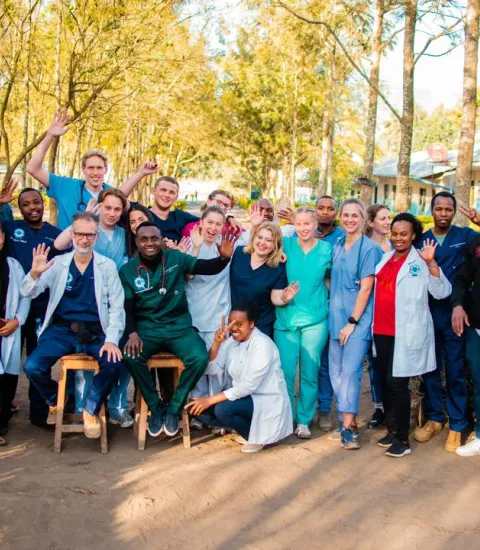
Through his work with the Health Community Outreach Program Tanzania and Medical Connect Africa, Dr. Kivuyo has spent years helping organize outreach initiatives that bring healthcare directly to underserved populations. These efforts range from basic consultations and preventive screenings to health education and maternal care support. Much of this work depends on volunteers: medical professionals, students, and local community members who step in where formal systems cannot fully reach. In many rural areas, these volunteers are the first point of contact with the health system. They provide information, build trust, and often determine whether individuals seek care at all. Yet their role remains largely absent from official statistics.
This disconnect, Dr. Kivuyo argues, has consequences. “If we don’t measure these efforts, they are not fully considered in decision-making,” he says. “And if they are not considered, we risk underinvesting in what actually works on the ground.”
Across health systems facing workforce shortages and geographic constraints, community-based initiatives have become an essential extension of service delivery. Preventive care, in particular, depends heavily on consistent engagement at the local level, some-thing volunteers are often uniquely positioned to provide. But without formal recognition in data systems, their contribution remains difficult to quantify and easy to overlook.
The challenge is not a lack of impact. It is a lack of visibility. This is where the State of the World’s Volunteerism Report introduces a shift in perspective. Rather than focusing solely on participation numbers or economic estimates, the report proposes ways to measure how volunteerism contributes to outcomes, including in sectors like health where its role is often indirect but significant.
For practitioners like Dr. Kivuyo, this approach reflects a reality long understood in the field.
“We have always known that community engagement and volunteerism are essential to health outcomes,” he says. “What is changing now is that we are starting to have tools to explain that in a way that systems can understand and act on.”
The implications extend beyond recognition. Better measurement can influence how re-sources are allocated, how programmes are designed, and how health systems respond to future challenges. It can also help bridge the gap between formal institutions and the communities they serve. In practice, this means capturing not only how many people are involved in volunteer efforts, but what those efforts achieve. It means understanding how trust is built, how early interventions prevent more serious conditions, and how local engagement shapes health behaviour over time.
“Better measurement means better decisions,” Dr. Kivuyo says. “It helps governments see where support is needed, how to strengthen outreach, and how to build more resilient health systems that include communities as active partners.”
For now, much of this work continues outside formal systems of record, sustained by networks of individuals committed to improving access where it is most limited. But as attention shifts toward evidence and accountability, the question is no longer whether these contributions matter. It is whether they will be fully seen.
For Dr. Kivuyo and others working at the intersection of clinical care and community out-reach, the issue is not theoretical. It is immediate and practical. They are already building solutions, often with limited resources, in environments where the margin for error is small. What they increasingly expect is that governments and institutions meet them halfway.
Reports like the State of the World’s Volunteerism Report and frameworks such as the Global Index of Volunteer Engagement for Dr. Kivuyo offer more than analysis. They provide a pathway to turn experience into evidence and evidence into policy. There is a growing expectation among practitioners that this shift will not remain at the level of global discussion, but will be reflected in national health strategies, in statistical systems, and in how impact is defined, measured, and funded.
“We see every day what works,” Dr. Kivuyo says. “Now we need systems that see it too.”
For community health workers and volunteers, measurement is not about recognition alone. It is about ensuring that effective models are sustained, scaled, and integrated into the future of health systems. It is about moving from isolated success to systemic impact. The frameworks now exist. The evidence is growing. What remains is the decision to use them. And for those already carrying much of the burden of care at the community level, that decision cannot come soon enough.