


Putting Volunteering on the Social Value Agenda
The 3rd Korea Social Value Festa 2026, held at COEX in Seoul from September 21 to 22, is Korea's leading social value platform where the government, businesses, civil society, social enterprises, international organizations, academia, and citizens gather to seek solutions to social issues. Hosted by the Korea Chamber of Commerce and Industry (KCCI), this year's event brought together around 400 organizations to operate over 300 exhibition and market booths alongside 50 sessions and special programs, attracting approximately 15,000 visitors over two days. Major corporations and public institutions, including SK hynix, SK Telecom, Korea Railroad Corporation (KORAIL), and Hyundai Marine & Fire Insurance, also presented cases of addressing social issues using their respective technologies and resources.
The Korea Volunteer Center participated as a co-organizer of the event for the first time in 2026. Rather than limiting its role to recruiting and managing citizen volunteers for the event, the Center positioned volunteering as a core agenda item for discussing social values and addressing social challenges through exhibitions and forums. While businesses offered technology and capital, the government provided policy and institutions, and civil society contributed field expertise and ideas, the core objective of the Center's participation was to visualize the role of volunteers—who discover issues, take action, and connect people with resources in local communities—as a vital pillar in the ecosystem for solving social problems.
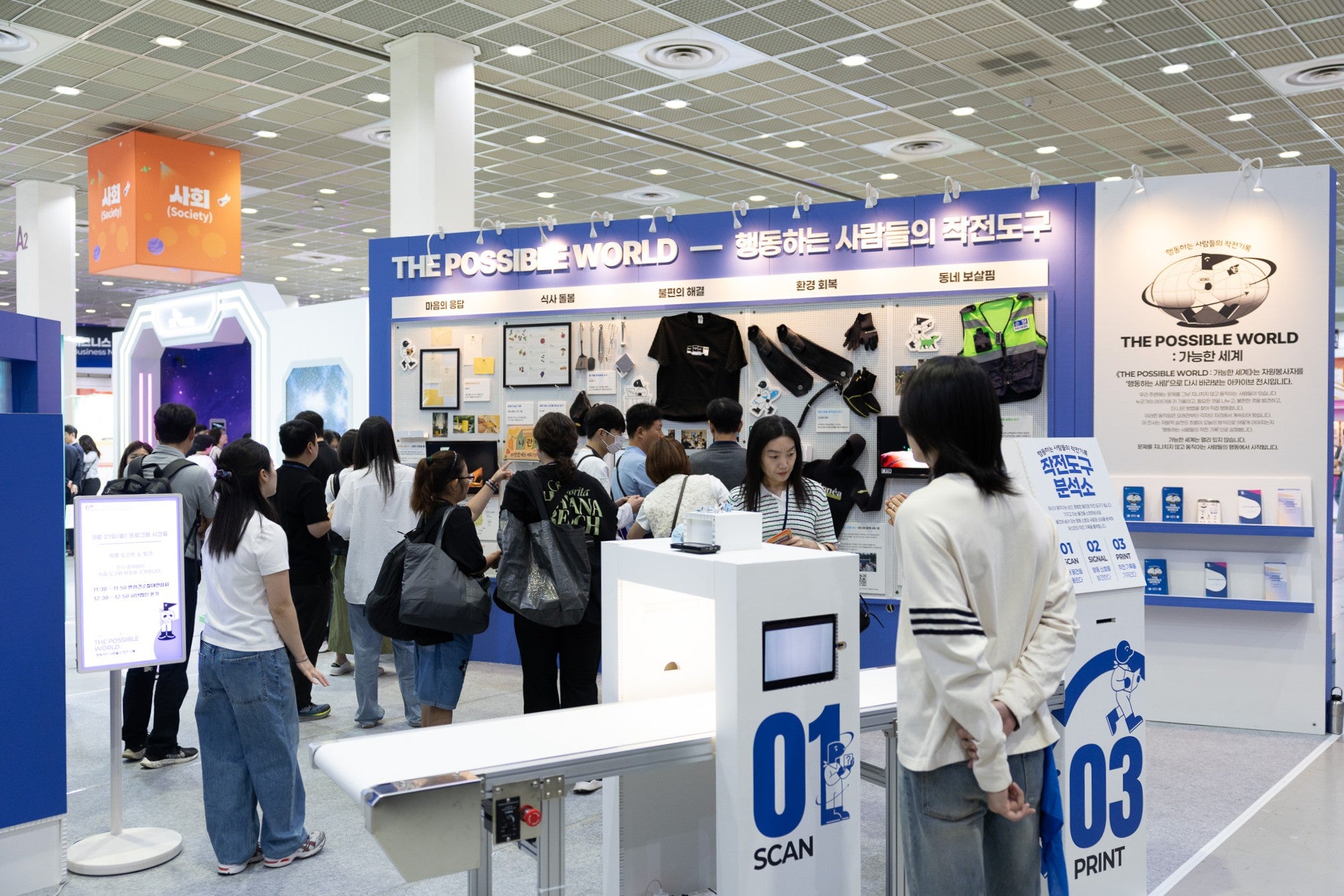
The first program demonstrating this vision was the special exhibition THE POSSIBLE WORLD: Records of People in Action. The exhibition defined volunteers as "people who do not turn a blind eye to social issues but take action," illustrating how such actions begin in daily life. It showcased how ordinary hobbies, skills, and everyday items are transformed into resources for solving social problems—such as a citizen who enjoys diving recovering underwater debris, or a local resident walking a dog observing and reporting hazards in the neighborhood.
At the interactive station Action Tool Scanner, visitors scanned their belongings to explore how they could lead to social actions like care, connection, environmental protection, or sharing. Rather than presenting volunteering as a separate, extraordinary activity, this interactive experience aimed to frame it as a way for individuals to connect their existing experiences, skills, and interests with societal needs. Over the two days, 1,480 people visited the exhibition, and 772 participated in the Action Tool Scanner.
On the second day, the Korea Volunteer Vitality Forum, titled Creating Value Through Volunteering: Hospitality, Inclusion, Healing, and Solidarity, discussed the role of volunteering in responding to population decline and regional extinction through the lens of "relationships." The forum moved beyond viewing regional sustainability strictly through demographic fluctuations, highlighting instead the "relational capital" built when diverse individuals meet, establish trust, and collectively address shared issues.
Cases from four regions supported by the Korea Volunteer Center's grant project illustrated this approach in concrete detail. In Chilgok-gun, Gyeongsangbuk-do, volunteers consistently visited residents isolated for decades due to the social stigma surrounding Hansen's disease, offering greetings, listening to their stories, and documenting their lives and community memories. In Siheung-si, Gyeonggi-do, residents with immigrant backgrounds expanded their roles from being beneficiaries of local support to active contributors solving local problems through multilingual translation and interpretation services. In Taean-gun, Chungcheongnam-do, volunteers acted as "relationship guides," connecting new residents with the community to assist their settlement and local participation. In Hadong-gun, Gyeongsangnam-do, "voluntours"—combining travel with volunteer activities such as planting trees in fire-damaged areas and assisting with tea leaf harvesting—created new avenues for visitors and local residents to build meaningful connections.
While voluntary citizen action exists on the front lines of issues such as regional extinction, climate change, caregiving, and social isolation, its contributions are not always recognized as volunteering or adequately reflected in discussions on policy and resource allocation. The Korea Volunteer Center's participation in the Korea Social Value Festa was an endeavor to expand the volunteer agenda into a broader platform where businesses, the government, and civil society jointly discuss solutions to social problems. Recognizing voluntary citizen participation as a vital resource for solving social issues and achieving sustainable development, while connecting it with collaborative frameworks across policy, corporate, and civil sectors, serves as a key pathway for translating IVY 2026 into practice in Korea.