












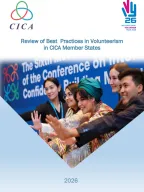
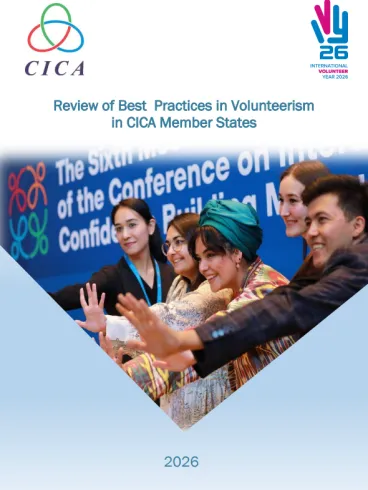
Review of Best Practices in Volunteerism in CICA Member States
Share on social media


Fast Read
The Review of Best Practices in Volunteerism in CICA Member States (2026) highlights how volunteerism is becoming a strategic tool for strengthening social cohesion, youth development, community resilience, and sustainable development across Asia. The publication documents policies, legal frameworks, volunteer platforms, and flagship initiatives from CICA member states, demonstrating that volunteerism is evolving from informal community support into structured national systems
Summary
The review presents a comprehensive overview of volunteerism across CICA member states and demonstrates its growing role in supporting social well-being, sustainable development, and regional cooperation. Volunteerism is portrayed not merely as charitable activity but as an organized mechanism for strengthening civil society, empowering youth, and building community resilience.
CICA's Role in Volunteerism
Since 2023, CICA has progressively elevated volunteerism within its agenda through the adoption of the Statement on Promoting Volunteerism for Sustainable Development, the inclusion of volunteerism in the Catalogue of Confidence Building Measures, and the organization of volunteer leadership rallies. These initiatives position volunteerism as a key instrument for trust-building and regional cooperation.
Common Trends Across Member States
The review identifies several common developments:
- Institutionalization of Volunteerism
- Countries are adopting dedicated laws, policies, and volunteer management systems.
- Governments increasingly recognize volunteerism as a strategic development asset.
- Youth-Centered Approaches
- Most volunteer programs target young people as agents of social change.
- Volunteerism is increasingly integrated into education, leadership development, and employment pathways.
- Digital Transformation
- National volunteer platforms facilitate registration, opportunity matching, volunteer tracking, and impact measurement.
- Technology is making volunteer participation more accessible, transparent, and scalable.
- Disaster Response and Resilience
- Volunteer networks play critical roles during emergencies, natural disasters, and public health crises.
- Countries such as Bangladesh, Kazakhstan, India, Kyrgyzstan, and Pakistan demonstrate strong volunteer engagement in crisis response.
- Environmental and Sustainable Development Actions
- Many volunteer initiatives focus on climate action, waste management, conservation, and community sustainability projects.
- These efforts contribute directly to achieving the Sustainable Development Goals (SDGs).
Best Practices Identified
The publication highlights several practices that can be replicated across countries:
- Establishing national volunteer laws and regulatory frameworks.
- Creating centralized volunteer databases and digital recruitment platforms.
- Recognizing and incentivizing volunteer contributions through awards, certificates, and education or employment benefits.
- Integrating volunteerism into national youth strategies.
- Building partnerships among governments, NGOs, educational institutions, and the private sector.
- Measuring volunteer impact through statistics, volunteer-hour tracking, and social impact assessments.
Conclusion
The review demonstrates that volunteerism is becoming a powerful force for social transformation across Asia. Despite differences in culture, governance, and development levels, CICA member states share a commitment to mobilizing citizens, especially youth, to address social, economic, and environmental challenges. The publication concludes that stronger cooperation, knowledge sharing, and institutional support can further expand volunteerism's contribution to sustainable development, regional stability, and community resilience